MALAYSIA
Welcome to Malaysia
With its blend of modern cities, lush rainforests, and turquoise islands, Malaysia offers a mix of adventure and cultural depth that few places can match. From the futuristic skyline of Kuala Lumpur to the tea-covered hills of the Cameron Highlands, the country’s landscapes are endlessly varied. Travelers flock to Langkawi’s beaches, Borneo’s wildlife sanctuaries, and Penang’s world-famous street food scene. But what truly sets Malaysia apart is its harmony of cultures—Malay, Chinese, Indian, and Indigenous—creating a warm, welcoming atmosphere and a vibrant tapestry of traditions. Malaysia isn’t just a destination; it’s a rich, sensory experience you’ll never forget.




Non Profits in Malaysia
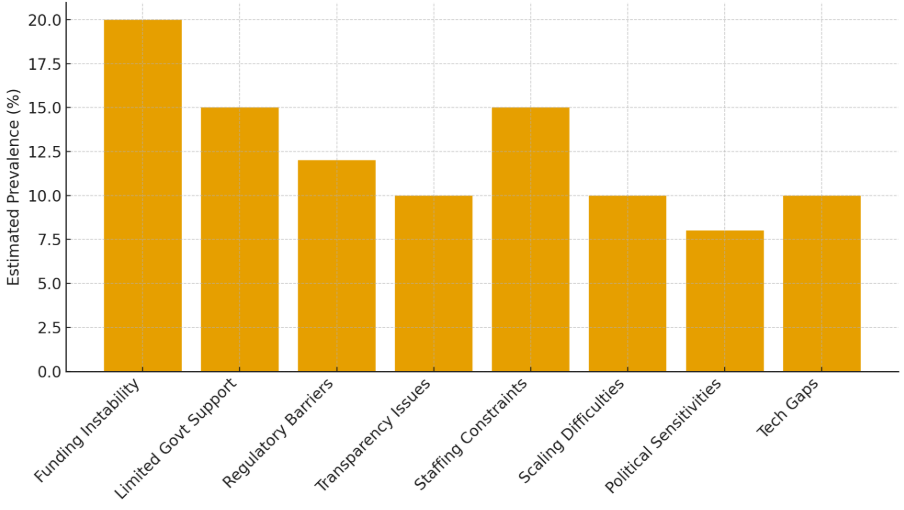
Estimated distribution of major operational and structural challenges encountered by Malaysian NGOs. Percentages reflect relative prevalence based on sector reports and observed trends.

Malaysia has a large nonprofit sector, with 80,000–95,000 registered NGOs across welfare, community, religious, and advocacy groups.
Because Malaysia is an upper–middle income country, it receives very little foreign aid, so most nonprofits rely on local funding sources.
Key funding comes from corporate CSR programs, local foundations, and community donations, rather than international grants.
Some nonprofits also generate income through social enterprises and fee-based services to support their operational costs.
Corporate (CSR) Funding:
Top 20 Malaysian companies donated RM 381.8 million in 2023.
Received by 78% of social development organisations (SDOs); on average, makes up ~14% of budgets.
Individual / Philanthropic Donations:
Received by 77% of SDOs.
Administrative costs can take 10–30% of donations.
Foreign Funding / International Grants:
41% of SDOs reported foreign funding; ~9% of budgets.
Sources include USAID, EU, JICA, World Bank.
Government Grants / Procurement:
58% of SDOs get government grants; 17% get procurement contracts.
Combined, they account for ~21% of budgets.
Income-Generating Activities / Social Enterprise:
56–66% of SDOs generate income from sales or services.
How NGOs Are Funded in Malaysia
Challenges Facing NGOs in Malaysia
Malaysian NGOs face a multifaceted set of challenges centered on achieving financial stability and navigating a complex operational and regulatory environment. Funding Instability is a foundational issue, stemming from a heavy reliance on fluctuating sources like corporate social responsibility (CSR) initiatives and public donations, which prevents sustainable growth. This project-by-project funding model makes long-term program scaling nearly impossible, keeping many organizations confined to local-level impact rather than achieving national reach. Exacerbating this financial strain is a pervasive Lack of Public Trust due to past instances of misused funds, prompting donor caution and a greater demand for rigorous financial transparency, a standard that many smaller NGOs struggle to meet.
Furthermore, internal Capacity and Staffing Constraints hobble operational effectiveness. Many organizations rely on a core team of underpaid staff and volunteers who are often overworked and lack access to essential training and professional development. This limitation also contributes to a noticeable Digital and Technology Gap, leaving many NGOs ill-equipped for modern data management, digital communications, and efficient online fundraising. On the external front, they must overcome significant Regulatory and Bureaucratic Barriers. The process for official registration under the Registrar of Societies (RoS) is often described as complex, and securing timely approvals for key activities, such as fundraising events or foreign funding, is frequently slow and cumbersome. This is particularly challenging for NGOs engaged in sensitive areas like human rights or governance, which face increased Political Sensitivities and scrutiny that can limit their advocacy work and create an uncertain operational climate.


Why Help?
NGOs in Malaysia need YOU.
Learn what you can do.
Common risks for Malaysian NGOs
Primary NGO sectors in Malaysia
Poverty Alleviation & Social Welfare
Healthcare & Public Health
Environmental Protection & Conservation
Education & Youth Development
Women’s Rights & Gender Equality
Refugee & Migrant Support
Disability Rights & Services
Animal Welfare
Community Development & Rural Empowerment
1. Funding Instability & Financial Risk
Heavy reliance on donations and CSR causes unpredictable revenue.
Foreign funding can trigger political scrutiny.
Weak financial controls increase the risk of misuse.
2. Regulatory & Legal Risk
Complicated compliance under the Societies Act and other laws.
RoS has broad discretionary powers (e.g., demanding documents, suspending activities).
3. Governance & Accountability Gaps
Many NGOs lack standardized governance mechanisms or transparency.
Insufficient oversight creates exposure to internal misconduct and public distrust.
4. Reputation & Public Trust Risk
Donations scandals and “pao culture” damage sector credibility.
Public skepticism reduces willingness to donate or collaborate.